Fast Result Check
Quick access to your BISE Faisalabad result portal.
Enter your roll number and select an exam session to continue to the official result source.
Quick access to your BISE Faisalabad result portal.
Results are verified through the relevant board website.
Check your result conveniently on mobile or desktop.
A practical, board-specific guide for checking marks, understanding the latest merit list and preparing more effectively for the next examination.
The table below records the first three overall positions, including every student where a position was shared. A dash means that a detail was not available in the accessible published list and has deliberately not been guessed.
| Position | Student | Roll Number | Marks | Subject / Group | School / Institution |
|---|---|---|---|---|---|
| 1st | Umna Salahuddin | 410732 | 1,191 / 1,200 | Overall SSC (Science) | The City Grammar School Girls Wing, New Civil Lines, Faisalabad |
| 2nd | Ramin Fatima | 424927 | 1,190 / 1,200 | Overall SSC (Science) | Divisional Public School for Girls, Rajana Road, Samundri |
| 3rd | Muhammad Raif Abdul Ahad | 484550 | 1,189 / 1,200 | Overall SSC (Science) | Iman Public Boys High School, 75/JB Sohal, Faisalabad |
Latest published SSC 2026 position-holder record. Shared positions are retained instead of removing tied candidates.
The BISE Faisalabad result is the formal academic record for school and private candidates in Faisalabad, Jhang, Toba Tek Singh and Chiniot. It confirms the student’s subject-wise marks, total, grade, pass status and eligibility for the next academic stage. This is an academically active division with strong competition across public and private institutions, so students should judge performance against the official syllabus and marking scheme—not only against classmates.
Important: the merit table contains 3 students because every shared position is retained. A small difference in total marks can come from presentation, an omitted calculation step, spelling, an incomplete definition or poor time control. Instead of asking why another student scored more, identify the habits that can improve your own next attempt.
Protect personal information: never publish a complete marks sheet on social media. For admission, scholarship or legal verification, use the original certificate or board-verified document requested by the institution.
If the official server is busy on announcement day, wait briefly and reload once. Repeated rapid submissions can make the experience worse. If the record is incomplete, note the roll number and contact the official board about correction or rechecking instead of depending on rumours.
For most matric and intermediate students, three to four focused hours outside class are more useful than a full day of distracted reading. A learner with unfinished concepts may need four to five hours. For Faisalabad candidates, a practical routine is one early-morning revision hour, two afternoon concept hours and one evening testing hour.
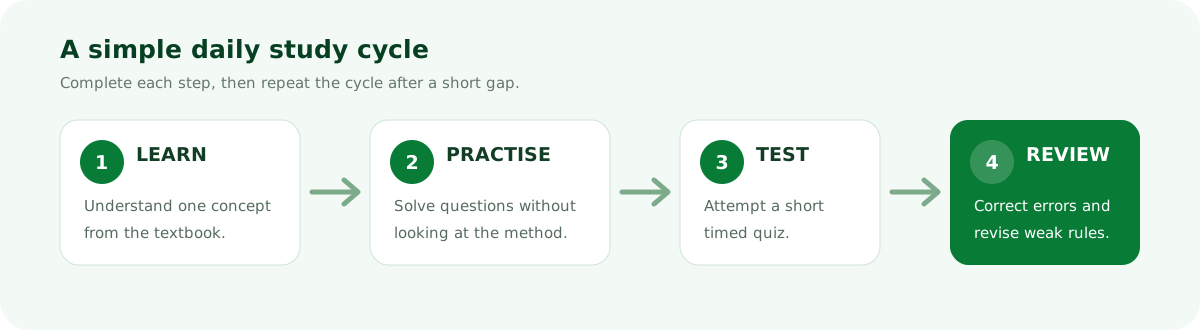
Studying for ten exhausted hours usually reduces recall. Increase the workload gradually, protect sleep and stop carrying every unfinished task into the next week. A smaller plan completed consistently beats an impressive timetable that is ignored after two days.
Understand one worked example, close the book and solve similar questions. Mark the exact step where an error begins.
Turn chapters into definitions, labelled diagrams, short questions and cause-and-effect links. Recall them without looking.
Practise grammar or translation daily. Write complete timed answers twice each week and check presentation.
Organise dates, references and long answers under clear headings. Use keywords rather than memorising unstructured pages.
Reading creates familiarity, but examinations require retrieval and writing. Close the book and explain the idea in your own words. If the answer is incomplete, reopen the source, repair the gap and test it again later.
PaperMCQs turns passive reading into frequent testing. After finishing a chapter, use subject MCQs to discover weak areas before a school test. For every incorrect answer, return to the relevant textbook section and explain why the correct option is right and why the remaining options are wrong.
MCQs do not replace descriptive answers, textbooks or teacher feedback. The strongest method is a repeated cycle: study → test → inspect the mistake → revise → retest after a gap.
Remember: one examination records one performance at one time; it does not define a student’s ability. Calm analysis, regular written practice and timely support can change the next outcome substantially.
Select another education board.